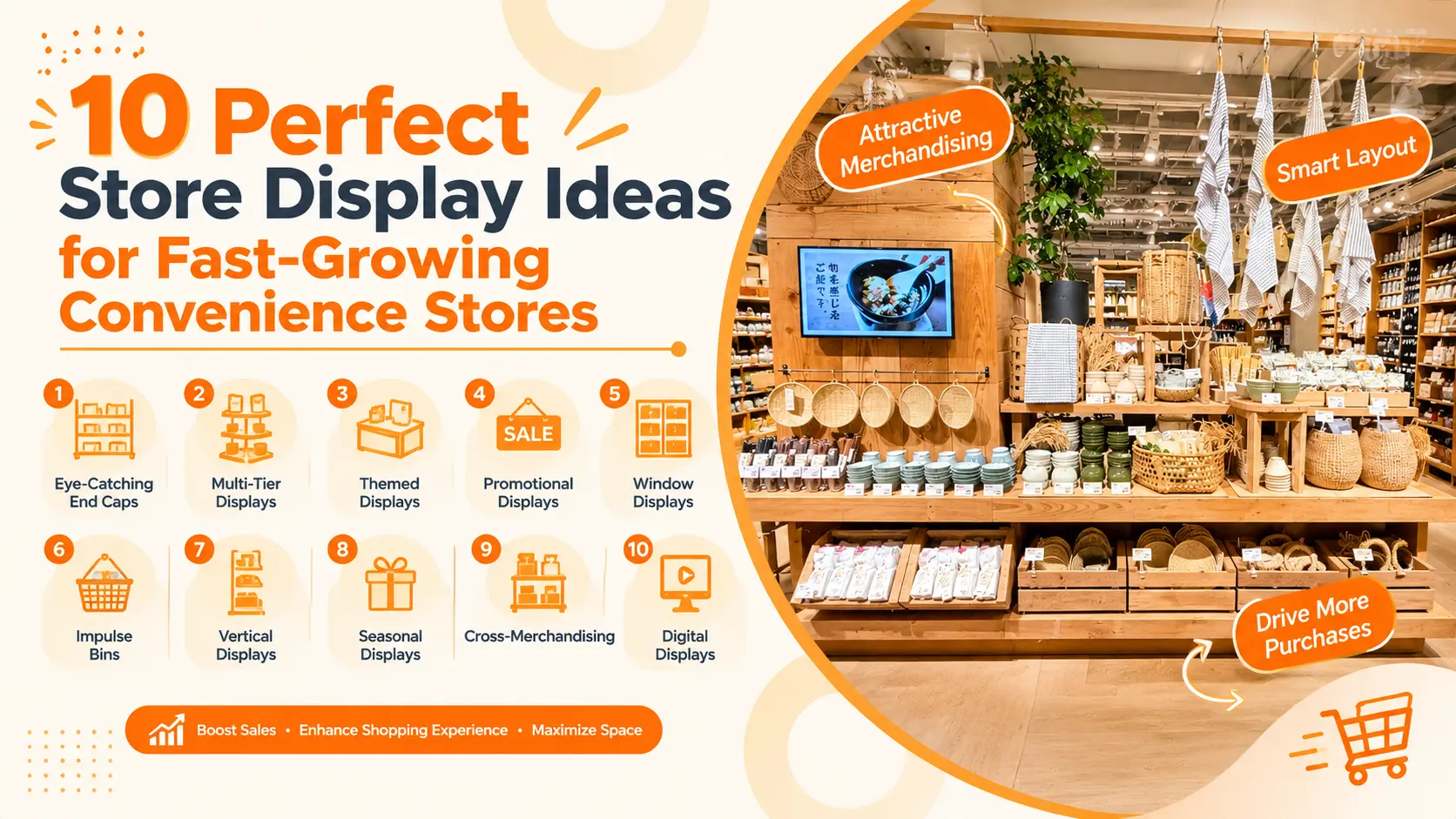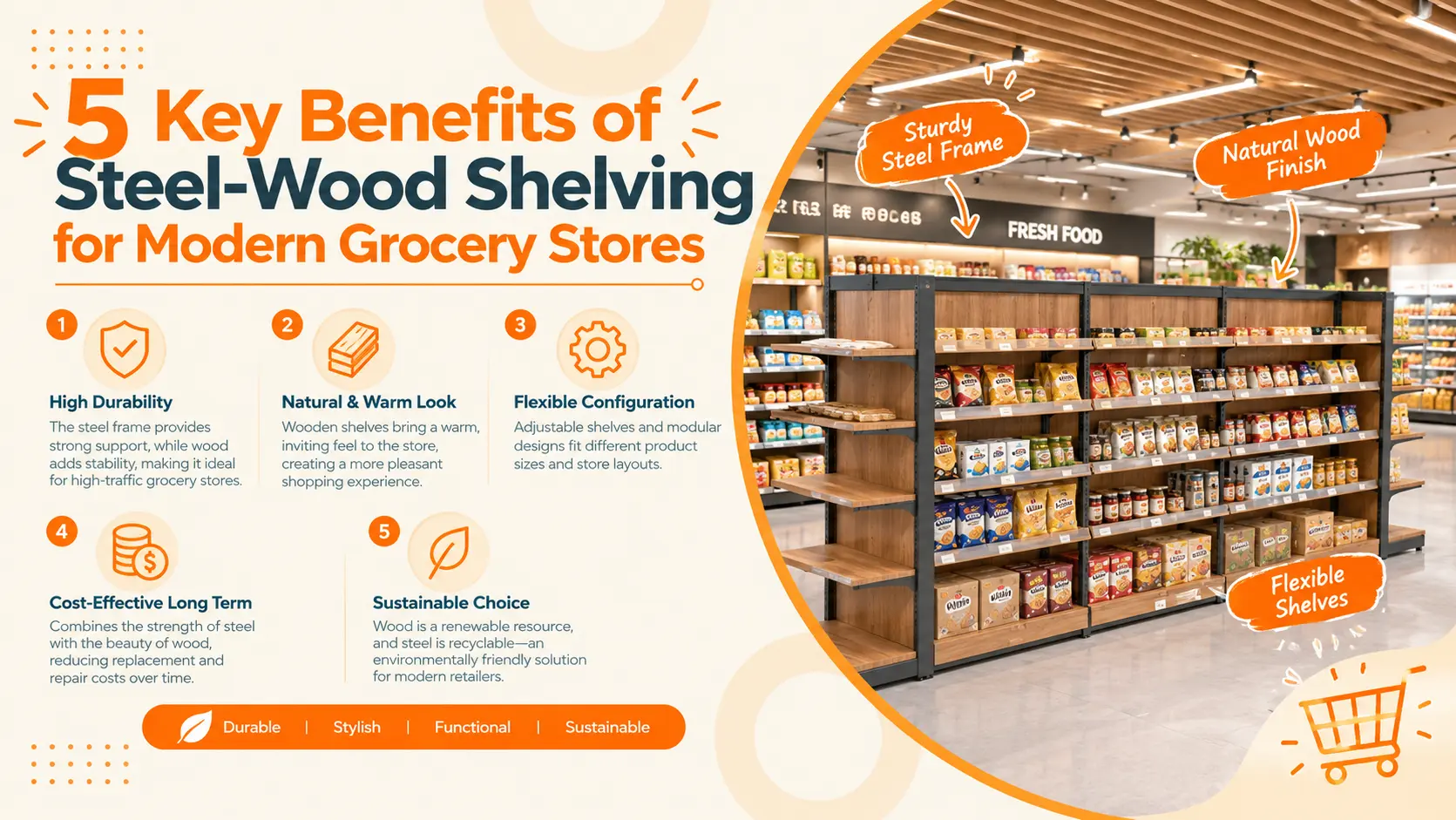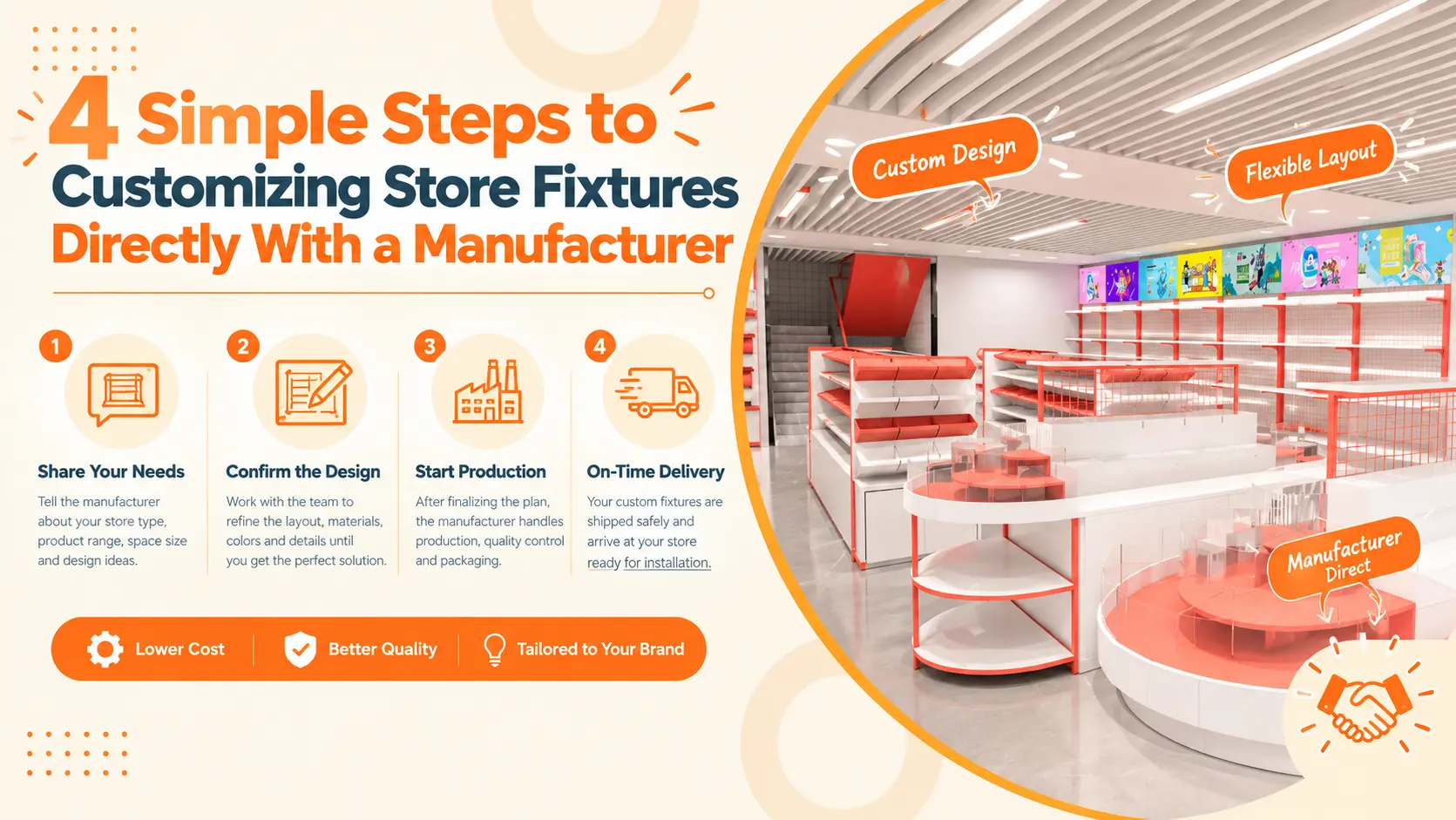
Beauty shoppers buy with their hands. They touch a lipstick, test a serum, and compare two foundations before they pay. The display units you choose decide where customers stop, what they try, and what finally lands in the basket. Yet many beauty stores buy fixtures once and never re-plan the layout. That is a missed sale every single week.

Key Takeaways
A beauty store needs a mix of freestanding, wall-mounted, and countertop display units. Together they cover main aisles, aisle ends, trial areas, perimeter walls, checkout, and premium zones. Here is the short version of what each unit does:
- Gondola shelving units — high-density product storage for main aisles
- End cap display units — impulse promotions at the ends of gondola runs
- Island tester display units — touch-and-try stations in open floor space
- Wall-mounted display units — slatwall and pegboard for perimeter walls
- Countertop display units — last-minute buys at the checkout counter
- Tiered step & riser display units — lift products to eye level
- Glass showcase display cases — locked, premium presentation
- Brand feature wall displays — a shop-in-shop for one brand
- Mobile rolling display units — flexible, movable promotions
- Acrylic cosmetic display racks — tidy storage for small items
Why Display Units Matter in a Beauty Store
Beauty products are small. A single shelf can hold forty items, and without a clear display every product looks like every other. Well-planned display units solve three problems at once:
- Visibility. Display units raise products to eye level, where shoppers actually look. Low shelves and cluttered counters hide your bestsellers.
- Try-on. Tester counters build trust. A customer who swatches a lipstick or sprays a fragrance is far more likely to buy than one who reads the box.
- Impulse. Checkout zones and end caps capture the unplanned purchases that drive most of the 70% in-store decision figure.
The goal is not more fixtures. It is the right fixture in the right place.
See how all these elements work together in a full beauty store transformation below:
1. Gondola Shelving Units — The Aisle Workhorse
Gondola shelving is the backbone of most beauty stores. These double-sided, freestanding display units carry the bulk of your assortment — serums, lotions, haircare, and body care — in long continuous runs across the middle of the floor.
- Best for: everyday core range, standard aisles
- Placement: center of the floor, joined into runs of 2–6 bays
- Typical spec: powder-coated steel, adjustable shelf levels, 30–60 kg (70–130 lb) load per shelf
- Back panel options: pegboard, slatwall, or solid panel
Key Benefit: One gondola bay shows many SKUs per square foot, and shelf heights reconfigure as your assortment changes. You are not locked into a layout.
Gondolas also pay for themselves over time: the shelf kits, dividers, and hooks can all be re-used when a brand line changes. For a deep dive on sizes, parts, and load capacity, see our gondola shelving system guide.
2. End Cap Display Units — Your Impulse Zone
End caps are among the most profitable square meters in a beauty store. Positioned at the ends of gondola runs and facing main traffic paths, they catch shoppers who are already walking past.
- Best for: new arrivals, bestsellers, bundles, seasonal promotions
- Placement: end of gondola runs, facing the traffic lane
- Rotation: swap the products every 4–6 weeks
- Boosters: shelf talkers, price cards, and “staff pick” signs
Pro Tip: Rotate end caps every 4–6 weeks. Customers stop noticing a display that never changes.
Because end caps are cheap to merchandise and easy to change, they are the fastest place to test a new product before giving it full gondola space. Check how end cap shelving fits your floor plan.
3. Island Tester Display Units — Try Before You Buy
Testers sell products. An island tester display unit is a low-height, freestanding station built for hands-on trial — usually round or rectangular, placed in open floor space so customers can walk all the way around it.
- Best for: testers of lipstick, foundation, eyeshadow, and perfume
- Spec: low height, 900–1,100 mm (35–43 in), so customers reach without bending
- Must-have: mirrors, tester bottles, hygiene wipes, clear signage
- Why it works: hands-on trial converts browsers into buyers, especially for color cosmetics
Keep testers replenished and wiped down. An empty or messy tester counter signals the opposite of what you want — it tells customers the brand is not cared for.
4. Wall-Mounted Display Units (Slatwall & Pegboard) — Perimeter Merchandising
The walls around your store are free display space. Wall-mounted display units use slatwall panels or pegboard to turn bare perimeter walls into high-capacity merchandising.
- Slatwall — clean, premium look; holds shelves, baskets, and hooks
- Pegboard — dense hanging of tools, brushes, and accessories
- Accessories: hooks, waterfall racks, wire baskets, acrylic shelves
- Placement: perimeter walls, back wall behind the counter
Slatwall or Pegboard — Which Fits Your Wall?
- Slatwall: premium finish, slower to load, good for glass and wood shelves
- Pegboard: highest density per panel, best for hanging small tools and brushes
Key Benefit: One wall system supports many fixture types, so you can change the display without changing the wall. That flexibility pays off every time a season changes.
5. Countertop Display Units — Checkout Impulse Buys
The checkout counter is a waiting room. Countertop display units turn that waiting time into sales by placing small, low-priced items within arm’s reach of the customer.
- Best for: lip balms, travel sizes, sheet masks, nail files, accessories
- Types: acrylic tiered trays, spinning racks, small stands
- Placement: checkout counter and reception desk
- Keep it tight: 4–6 impulse items max, refreshed weekly
Keep the counter uncluttered. If every inch is filled, customers see nothing. Four good items beat forty dusty ones. For a counter designed around your brand, ask us about custom display design.
6. Tiered Step & Riser Display Units — Eye-Level Is Buy-Level
Tiered step and riser display units are staggered shelves that put every row in view. Instead of one flat row of products, you get three or four steps of visibility in the same footprint.
- Best for: hero products, new launches, high-margin items
- Rule: products at eye level sell best
- Types: 3-step, 4-step, single-row risers; tabletop or floor standing
- Use with a planogram so every SKU stays visible
Pro Tip: Reserve eye-level shelves — roughly 1,200–1,500 mm (47–59 in) from the floor — for your highest-margin products. Put refills and basics on lower steps.
Risers are inexpensive, so buy them generously. They are one of the quickest ways to add display capacity to a tabletop, a gondola shelf, or a window display without touching the walls.
7. Glass Showcase Display Cases — Premium & Locked Products
Glass showcase display cases protect high-value products and raise their perceived worth. A serum behind glass reads as precious; the same serum on an open shelf reads as ordinary.
- Best for: luxury skincare, serums, perfume, high-value gift sets
- Features: tempered glass, LED lighting, lockable doors
- Effect: signals value, protects stock, reduces shrinkage
Open Display or Closed Case — When to Choose
- Open display: drives trial and browsing; suits mid-price products
- Closed case: needed for theft-sensitive or premium lines; keep a tester out front so customers can still touch
Example: A pharmacy-style beauty wall uses lockable glass cases for serums and open shelves for body care. Trial where it matters, security where it pays.
Do not lock everything. A store where nothing is touchable loses the try-on advantage entirely.
8. Brand Feature Wall Displays — Shop-in-Shop Statements
A brand feature wall gives one brand its own store-within-a-store. It is a dedicated wall display that presents a single line as a complete story — with logo, lighting, and hero product front and center.
- Best for: flagship brands, hero lines, new brand launches
- Elements: brand panel, logo, backlit lighting, hero product
- Placement: back wall or store entrance, high foot-traffic zones
Key Benefit: A dedicated brand wall tends to lift average order value, because customers who commit to a brand usually buy multiple items from the same line.
Feature walls also attract brand reps. A brand with a dedicated display is more likely to send trainers, samples, and promo materials to your store.
9. Mobile Rolling Display Units — Flexible Promotions
Mobile rolling display units sit on casters, so they follow the traffic. When a promotion ends, they roll back to storage instead of taking up permanent floor space.
- Best for: seasonal promos, pop-ups, window rotation
- Types: rolling carts, gondola units on casters, tiered trolleys
- Advantage: move to the door, window, or aisle as traffic shifts
Pro Tip: Use mobile units for holiday gift sets and limited drops, then roll them away when the promotion ends. You get the sales spike without the permanent footprint.
Mobile units are also the easiest way to test a location. Run a rolling display in a spot for two weeks; if it sells, invest in a permanent fixture there.
10. Acrylic Cosmetic Display Racks — Small Products, Big Order
Acrylic cosmetic display racks keep tiny products neat and findable. Because acrylic is transparent, the packaging sells itself — no shelf panel hides the product.
- Best for: lipstick, nail polish, single items, testers
- Types: tiered acrylic trays, wall racks, counter organizers
- Why acrylic: transparent, clean, lightweight, easy to wipe down
Material Options — Acrylic, Metal, or Wood
- Acrylic: clean and lightweight; suits gloss, polish, and small items
- Metal: durable and industrial; fits gondola and wall systems
- Wood: warm and premium; fits brand walls and boutique concepts
Small items sell better when they are organized. An acrylic rack that groups shades by tone does more than a bigger rack that jumbles them together.
How to Choose the Right Display Units for Your Beauty Store
There is no single fixture package that fits every store. Your mix depends on floor area, SKU count, and the shopper you are serving. This table is a starting point:
| Store type | Priority display units |
| Small boutique | Island tester, countertop, wall-mounted slatwall |
| Mid-size beauty store | Gondola, end cap, slatwall, tiered risers |
| Cosmetic chain / flagship | Feature wall, glass cases, full gondola runs |
| Pharmacy / hybrid | Glass cases, end caps, pegboard |
Before you order, run through five checks:
- Measure space and traffic flow before choosing fixture widths
- Match units to SKU count and product mix (liquids, tubes, glass)
- Set a budget per linear meter or square foot
- Align finishes with your brand look — powder coating, wood, or acrylic
- Confirm MOQ, lead time, and knockdown (KD) flat-pack shipping
Common Display Mistakes That Hurt Beauty Store Sales
- Overcrowded shelves that overwhelm customers and hide the bestsellers
- No testers or mirrors near the products, killing the try-on advantage
- Hidden prices that stop customers from buying
- Displays that block traffic flow and push shoppers past key zones
- End caps and feature walls never rotated, so the store looks frozen in time
Most of these are fixable with the fixtures you already own. When you are ready to upgrade, custom store fixture design lets you fix the layout and the look at the same time.
FAQ — Display Units for Beauty Stores
How many display units does a beauty store need?
It depends on floor area and SKU count, but a rough rule is 8–12 display units for a 50 m² (about 500 sq ft) store, plus a countertop unit per checkout. Start with the core four — gondola, end cap, tester island, and countertop — and add the rest as the assortment grows.
What are the best display units for a small beauty store?
Island tester, wall-mounted slatwall, and countertop units maximize a small footprint. They add display capacity without eating up floor space, and they cover trial, perimeter, and checkout — the three zones that drive most beauty sales.
Can I order custom beauty store display units wholesale?
Yes. As a factory-direct manufacturer, DAHO builds custom display units to your drawings or spec sheet, with MOQ, shop drawings for approval, and knockdown (KD) shipping to cut freight cost. Send us your product list for a quote.
What is the difference between gondola shelving and wall display units?
Gondola shelving is freestanding and double-sided, so it works in the middle of the floor. Wall display units mount to the wall and use only the wall side. Most stores use both — gondolas for the main range, wall units for the perimeter.
How much do beauty store display units cost?
Cost depends on material, size, finish, and quantity. Powder-coated steel gondolas cost more than acrylic counter units, but they carry far more weight and last longer. For exact pricing on your store layout, request a quote with your floor plan and product list.
Build Your Beauty Store Around the Right Display Units
You do not need twenty different fixtures. You need the right ten — placed where customers walk, stocked with products they can try, and rotated often enough to stay fresh. Start with gondolas for the range, add end caps and a tester island for impulse, and use walls and counters to fill the gaps.
DAHO Display is a factory-direct retail fixture manufacturer with 20+ years of experience, a 40,000+ m² facility, 30+ designers, and 10,000+ completed projects. We are ISO-9000 certified and build custom display units for beauty stores, pharmacies, and retail chains worldwide.
- Get a Quote — send your floor plan and product list
- View Full Catalog — browse standard display units

Ivy is a shelving specialist at DAHO, a supermarket shelving manufacturer in China. She shares practical knowledge on retail shelving design, metal and wood fabrication, and store display systems. She helps global retailers and wholesalers understand shelving structures and choose the right factory solutions.