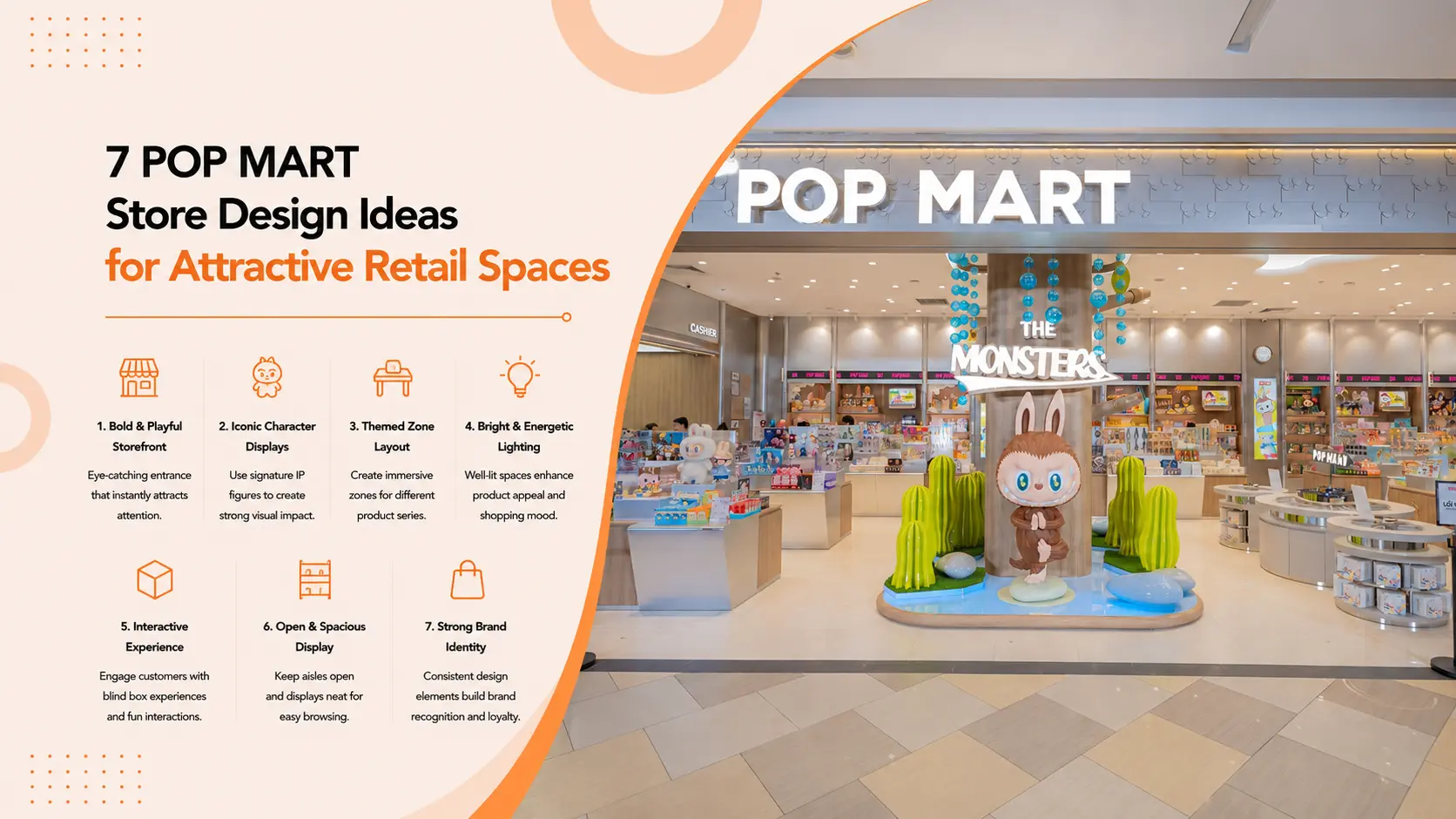
On September 3, 2022, POP MART opened its global flagship on Shanghai’s Nanjing East Road. Only the ground floor was open during the trial run. It still became the brand’s number-one offline store by sales. That’s not luck. It’s design.
Physical retail is bleeding foot traffic. Shelves alone don’t sell anymore. Spaces do.
This post distills seven store design ideas from real POP MART flagships in Shanghai, Bangkok, Beijing, and Chengdu. Each idea comes with the ROI data behind it, so you can decide what to copy first. Whether you’re opening a toy shop, a boutique, or a café, these principles transfer. And when you’re ready to turn them into fixtures, the right store fixtures and display solutions make the difference between a Pinterest board and a working store.

Key Takeaways
- A bold storefront facade can lift foot traffic by up to 23% (VM Retail Magazine).
- IP story zones boost brand recall by ~25% and turn one-time buyers into collectors (HubSpot).
- A single photo-worthy corner turns customers into content creators: 79% of consumers say user-generated content influences their purchasing decisions (Consumer Behaviour Stats).
- Eye-level products are ~82% more likely to be purchased than those above or below sightlines (Retail News & Insights).
- Every 1% increase in dwell time drives roughly 1.3% more sales (Path Intelligence).
1. How Does a Statement Facade Turn Passersby Into Visitors?
Window displays lift store foot traffic by roughly 23% (VM Retail Magazine). POP MART doesn’t just dress its windows. It turns the entire storefront into a billboard.
Take the Shanghai global flagship. A four-story SKULLPANDA facade rises above the Nanjing East Road intersection. Gradient lighting washes across the character’s face at night. You can see it from a block away. The store doesn’t wait for shoppers to walk in. It reaches out and pulls them.
In Bangkok, the ICONSIAM Global Landmark Store pushes even further. A four-meter MOLLY figure in traditional Thai attire rides an elephant on the riverfront terrace. These aren’t decorations. They’re traffic magnets.
The design logic is what rtdisplay calls the “transparency window effect.” Large glass walls erase the barrier between street and store. Brand-color light strips trace the edges. At night, the building glows like an energy halo. Passersby can’t help but look. And looking is the first step toward walking in.
Does your storefront do that? Or does it blend into the mall corridor?
Eighty percent of shoppers base buying decisions on what they see in-store (Home – Shop! Association). If they never step inside, the battle is already lost. A statement facade fixes that before the door even opens.
2. Why Do IP Story Zones Replace Plain Product Shelves?
Storytelling displays boost brand recall by about 25% (HubSpot). That’s the difference between a customer who buys one blind box and a customer who collects the entire line. POP MART builds every flagship as a narrative arc, not a shelf grid.
Shanghai’s two-floor layout runs from “Color Force Field” on the ground level to “Space MOLLY’s Secret Planet” upstairs. The ground floor explodes with neon and colored acrylic. The second floor shifts to silver metal and mechanical textures. You’re not shopping. You’re traveling through a story.
In Beijing’s Sanlitun store, THIRTY NINE designed a “Surprise Parade” concept across 189 square meters. Each major IP gets its own zone. LABUBU lives in a warm forest of curved wood and soft light. MOLLY holds a paintbrush in a gallery corner. SKULLPANDA poses in one of her time-traveling personas. Modular display shelves organize the space without walls, so each character still feels like part of a single world. If you need the same flexibility, custom display shelves let you reconfigure zones without rebuilding walls.
The MEGA collection area arrays 400% and 1000% scale figures in sculpted niches. Relief walls introduce each IP’s backstory. It’s part playroom, part gallery. And it works. Impulse purchases account for 20-40% of in-store sales, driven in large part by visual merchandising (FELBRO). When the display is a story, the impulse becomes a habit.
No English outlet has published a full timeline of POP MART flagship openings. Here’s a quick reference compiled from design press and local reports:
| Store | City | Area | Design Firm | Opening | Core Concept |
| Global Flagship | Shanghai | ~500 sqm | X+Living | Sept 2022 | Future tech / Space MOLLY |
| Global Landmark | Bangkok | 760 sqm | X+Living | Aug 2025 | Thai water culture / “Window to Fantasy” |
| Flagship | Beijing Sanlitun | 189 sqm | THIRTY NINE | Sept 2024 | “Surprise Parade” |
| Flagship | Shanghai IFC | 148 sqm | THIRTY NINE | Nov 2024 | “Surprise Parade” |
| Flagship | Chengdu Kuanzhai | N/A | Z+DESIGN | Jul 2020 (designed 2019) | “Molly Enters Sichuan” |
| Flagship | Chengdu IFS | ~700 sqm | N/A | July 2026 | Bamboo / LABUBU |
3. What Makes a “Check-in” Corner Worth Sharing?
Social-media-worthy displays turn shoppers into unpaid photographers. And their photos sell: 79% of consumers say user-generated content influences their purchasing decisions (Nosto). UGC also converts at 4.5% higher rates than brand content. For POP MART, that means every photo snapped inside the store is free advertising with better ROI than a paid campaign.
ICONSIAM leans into this deliberately. Curated photo zones are built into the architecture at key sightlines. Visitors pose with giant figures, post to Instagram, and tag the location. The store doesn’t buy reach. Its customers generate it, and that organic content converts 4.5% higher than paid ads.
Chengdu’s Kuanzhai Alley store goes deeper. Z+DESIGN staged “Molly Playing Mahjong” and “LABUBU Drinking Tea” scenes that merge Sichuan teahouse culture with the brand’s universe. These props are culturally specific backdrops that locals recognize and tourists love.
The newer Chengdu IFS flagship, opened in July 2026 at roughly 700 square meters, adds a bamboo pillar photo point. LABUBU peeks from behind the glass wall. It’s designed for the camera before it’s designed for the shelf.
When did you last see a customer pose for a photo in your aisle? If your store doesn’t have at least one corner worth photographing, you’re invisible to a generation of shoppers.
4. How Do Interactive Tech and Smart Fixtures Lift Engagement?
Interactive displays increase product engagement by about 40% (POPAI UK & Ireland). POP MART doesn’t bolt tablets onto walls. It embeds interactivity into the building itself.
At the Shanghai flagship, a ceiling conveyor belt moves products overhead like a factory of dreams. Large metal sphere fixtures embed screens that play POP MART news and animations. The design team calls them the “control heart” of the space. Some structural components were 3D-printed, ranging from one centimeter to three meters in size. That level of precision isn’t cheap. But it creates a space that feels alive.
On-site trial-draw stations let customers open blind boxes in the store. The fun of unboxing happens inside the store, not at home. That keeps people inside longer. And longer stays mean higher conversion.
By the end of 2025, POP MART operated 2,637 robot vending machines globally. The machines feed the same interactive ecosystem.
Stores with immersive experiences see visits that last 40% longer and sales that run 30% higher (Mapsted Indoor Positioning Platform, August 2025). Interactivity pays.
5. How Do Localized Cultural Themes Deepen Emotional Connection?
Seventy-three percent of customers say good visual merchandising makes them more likely to return (Visual Merchandising Store Design, 2020). POP MART uses local culture as its merchandising hook. The result is stores that feel like landmarks, not franchises.
The Chengdu Kuanzhai store, designed by Z+DESIGN in 2019 and opened in July 2020, fused “Molly Enters Sichuan” with a heritage courtyard. Blue-brick walls. Black-tile roofs. A teahouse scene where MOLLY wears a panda outfit. Visitors don’t just buy toys. They buy a piece of Chengdu.
ICONSIAM takes the same approach for Bangkok. Thai water-culture curves flow through the ground floor, inspired by the Chao Phraya River. The second floor integrates geometric “pixel cube” forms drawn from Wat Arun’s architecture. It’s Thai heritage translated into toy-store language.
The July 2026 Chengdu IFS flagship adds bamboo motifs throughout its roughly 700 square meters. LABUBU peeks from behind glass walls. City-exclusive products seal the deal. Panda MOLLY keychains and Shanghai-series badges turn the store into a souvenir destination. You can’t get them anywhere else.
Local culture gives shoppers a reason to come back.
6. Why Is Transparent, Flexible Merchandising Key to Conversion?
Eye-level products are roughly 82% more likely to be purchased than those placed above or below the natural sightline (Retail News & Insights). POP MART’s acrylic and metal systems are engineered for that exact rule.
At the Shanghai flagship, colored acrylic cases make the toys appear to float. Sightlines stay open across the entire floor. You can see product from the entrance to the back wall. Nothing blocks the view or hides the merchandise.
The wall racks combine metal frames with transparent acrylic shelves. Shelf spacing adjusts to fit blind boxes, standard figurines, or oversized MEGA pieces. That flexibility matters when your product mix changes every month.
Island counters use mirrored stainless-steel tops and small spotlights. Bestsellers sit under direct light. The reflection doubles the visual impact. High-velocity blind box walls are arranged for grab-and-go. The average product decision takes just seven seconds (P&G’s “First Moment of Truth”; POPAI Shopper Engagement Study). If the customer has to hunt, you’ve already lost the sale.
How many of your bestsellers sit at eye level right now?
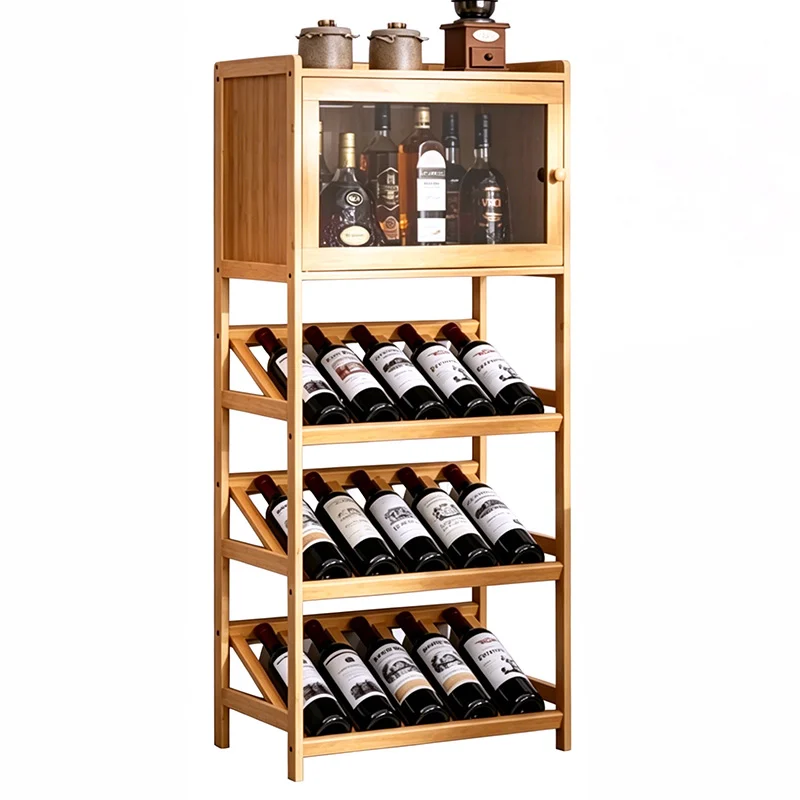
The fixtures do the selling. Transparent acrylic display shelves and adjustable custom store shelving let you apply the same eye-level rule to any product size, not just toys.
7. How Do Cafés, VIP Lounges, and Play Zones Extend Dwell Time?
A 1% increase in dwell time drives approximately 1.3% more sales (Path Intelligence). POP MART doesn’t just want you to browse. It wants you to stay.
ICONSIAM houses the first POP MART Café outside China, on the second floor. It’s a partnership with Greyhound Cafe. The menu draws from character backstories. You can sip a drink inspired by MOLLY’s space adventure while you wait for the next limited drop. The café turns retail into a leisure hub.
The same store includes a MEGA Zone, a POP BEAN zone, and a VIP lounge. Beijing and Shanghai use slow-browse circulation paths. The “Surprise Parade” layout doesn’t force a single route. Shoppers wander through curved walls and layered columns. They bump into unexpected installations. Every corner offers a reason to pause.
Customers now expect stores to entertain them. If your space only sells, they’ll leave as soon as the transaction ends. If your space also hosts, they stay. And while they stay, they buy more.
What happens in your store after the customer pays?
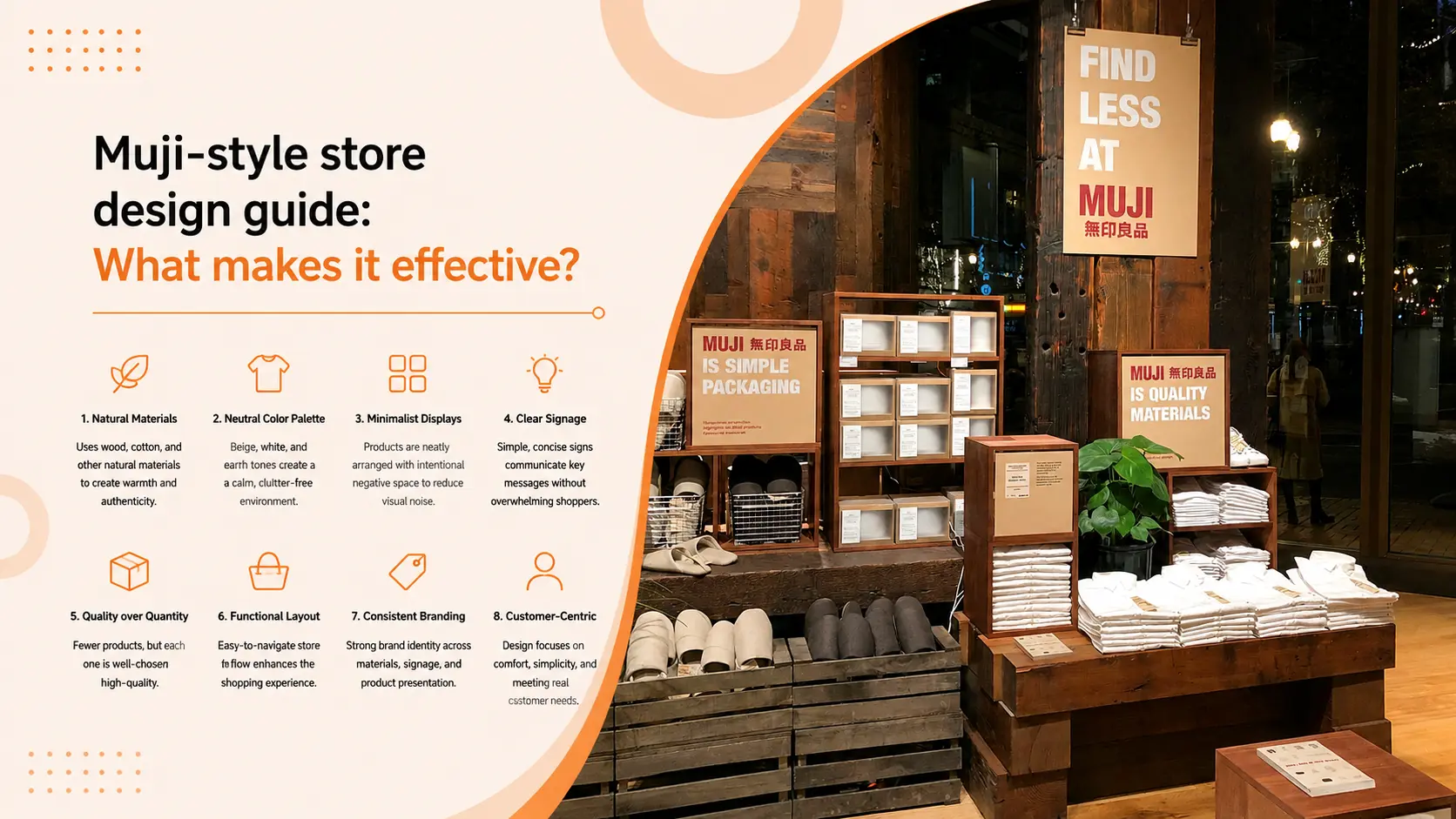
Want to engineer longer visits without a full renovation? Start with the same principle DAHO explored in our Muji-Style Store Design: 7 Lessons for Retail Layouts breakdown: calm circulation, clear sightlines, and comfortable pause points keep people inside longer than any gimmick.
Frequently Asked Questions
Why does POP MART design such elaborate stores?
Because immersive design pays. Stores with immersive experiences see visits that last 40% longer and sales that run 30% higher. POP MART’s 2025 revenue grew 184.7% to RMB 37.1 billion, supported by 630 stores in 20 countries. The stores are the engine, not the decoration.
Which POP MART store is the largest?
The Bangkok ICONSIAM Global Landmark Store at 760 square meters, opened August 2025 and designed by X+Living. It surpassed the roughly 500-square-meter Shanghai global flagship.
How much does experiential retail cost?
Global experiential retail spending reached $128.35 billion in 2024 (EventTrack). The spectrum is wide. A full 3D-printed flagship architecture costs millions. A low-cost modular pop-up kit costs a fraction of that. The ideas in this post scale down.
Can a small store use these ideas?
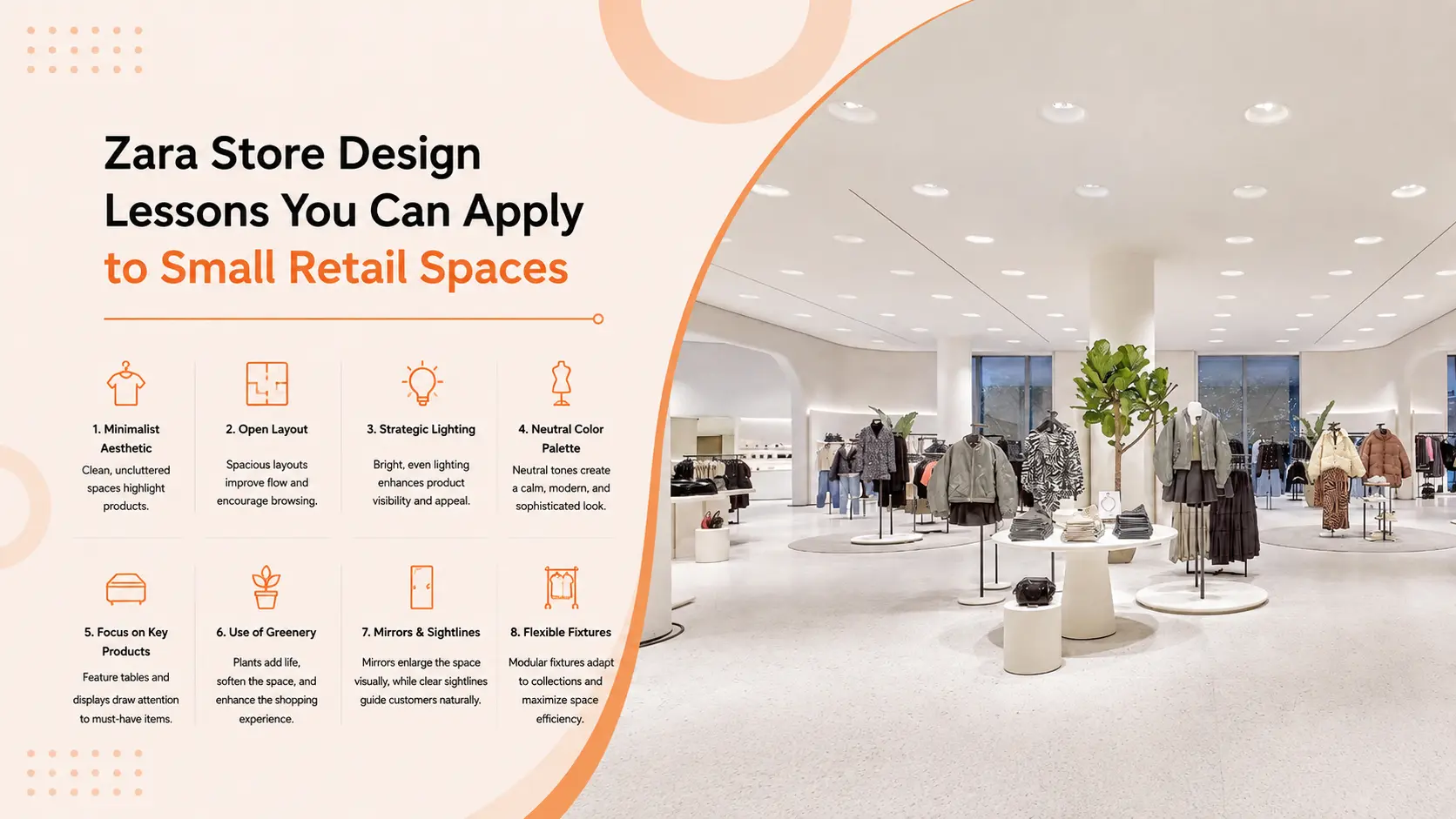
Yes. The transferable core is simple. Add window transparency for a 23% foot-traffic lift. Reset products to eye level for an 82% purchase-likelihood gain. Build one photo-worthy corner: 79% of consumers say UGC influences their purchasing decisions. Add any dwell-time feature, because 1% more dwell time equals 1.3% more sales.
Conclusion
POP MART’s stores are engineered unboxings. The facade pulls traffic. The story zones build memory. The check-in corners generate free marketing. Interactive fixtures drive engagement. Local culture creates landmarks. Transparent merchandising converts browsers into buyers. And cafés buy time.
You don’t need a 760-square-meter budget to copy these store design ideas. Start with the cheapest wins. Make your window transparent. Reset your best sellers to eye level. Stage one corner for photos. Add a single reason for customers to stay five minutes longer.
When you’re ready to turn those ideas into fixtures, DAHO provides one-stop design, sampling, manufacturing, and shipping for custom retail displays. Download DAHO’s full catalog to see the acrylic, metal, and modular shelving systems that bring these design principles to life.

Ivy is a shelving specialist at DAHO, a supermarket shelving manufacturer in China. She shares practical knowledge on retail shelving design, metal and wood fabrication, and store display systems. She helps global retailers and wholesalers understand shelving structures and choose the right factory solutions.