Most stores have a few fixtures that look tired but still do their job. Clean them properly, reset the shelves, replace worn accessories, and fix the labels before pricing a whole new run. Do not treat a damaged upright, loose anchor, or overloaded shelf the same way. Those faults need repair or replacement.
This guide is for retailers, buyers, and fit-out teams with a limited budget. It covers the small fixes worth trying first, then the point at which used, standard, or custom replacement makes more sense.
Key Takeaways
- U.S. accessible routes generally require 36 inches of clear width, so a fixture move must protect the route (U.S. Access Board)
- DOE says quality white LEDs can last 30,000 to 50,000 hours
- Check condition, component compatibility, and product fit before buying replacement fixtures
- Keep a sound frame and replace only the parts that affect safe use or presentation
- Trial one visible bay, then record the parts, reset time, and replenishment routine before a wider rollout
- For a repeat store format, turn the approved trial into a drawing and component schedule
The cheapest answer is often better information. Record SKU size, weight, facings, and replenishment method before changing a bay.
For the wider floor plan, see our supermarket layout strategies. These ideas work better once the customer path and service route are known.

Which store fixtures should you upgrade first?
Deal with loose, damaged, or obstructive fixtures first. After that, look at the bays customers touch every day. The U.S. Access Board calls for a 36-inch continuous clear width on accessible routes; check the rules for the specific country and site before moving anything.
Walk the store from the entrance to the counter. Note unstable bases, bent uprights, missing shelf clips, damaged edges, poor sightlines, and displays that force customers into a tight path.
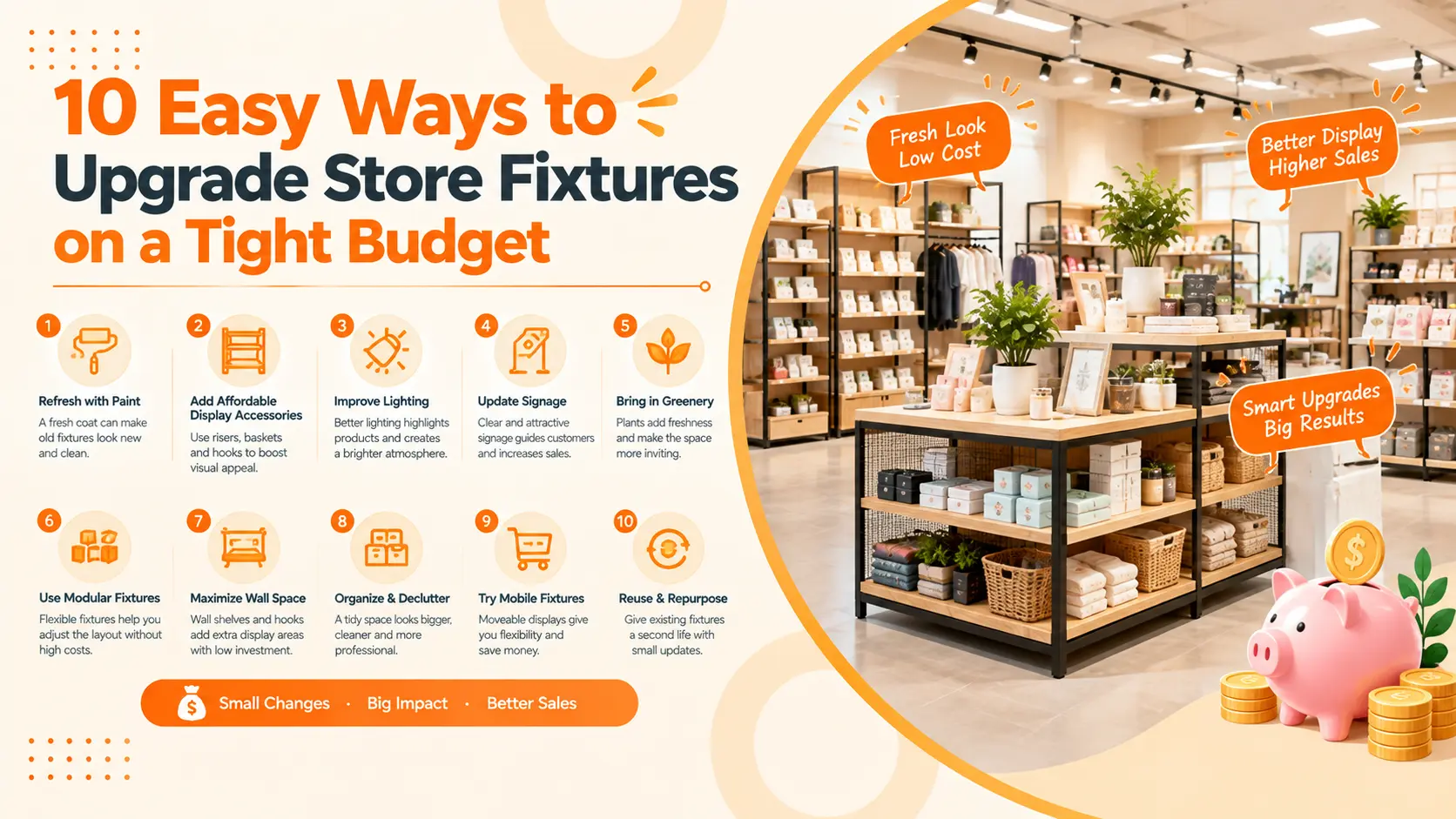
Five low-cost ways to refresh existing fixtures
Focused lighting can be worth trying before you replace an entire fixture. Check the frame, shelf supports, and mounting points first. The DOE source and its 30,000-to-50,000-hour LED lifespan range appear in the Key Takeaways.
1. Clean, declutter, and repair one bay at a time
Start by removing stock, labels, adhesive residue, and dust. Tighten accessible fasteners, replace missing feet or end caps, and check that casters lock where they should. Use a cleaning method suited to the material and finish. A clean powder-coated steel frame and a clear shelf edge often change the customer impression more than a new fixture does.
Do not hide corrosion, bent components, cracked welds, or unstable panels with a quick clean. Photograph those faults and ask the fixture supplier or site team what can be repaired. This one check protects the budget from being spent on a display that should leave the floor.
2. Refinish surfaces that are structurally sound
Refinishing works best when the problem is visual wear, not damage. Match the method to the substrate. Powder-coated steel, laminate, solid wood, MDF, and melamine-faced board all need different preparation, repair, and curing steps. Test a small concealed area before committing to a full bay.
Choose a finish that fits the cleaning routine and the rest of the fixture run. A fresh colour can make an isolated table look intentional. Mixing several new finishes across one small store usually has the opposite effect. Check lease terms before permanent changes in a rented unit.
3. Replace accessories before replacing the frame
Shelf-edge rails, dividers, brackets, hooks, baskets, sign holders, and damaged back panels can age faster than the main structure. Replacing them can reset how a bay works without changing its footprint. The important part is compatibility: shelf pitch, hook pattern, bracket profile, and approved loading must match the existing system.
For an adjustable system, use the same discipline you would use with a new order. Record the upright profile, shelf depth, shelf width, and back-panel type. Our gondola shelving system guide can help turn those observations into a clear component brief.
4. Improve light at a focal display
Use LED lighting where it helps customers see a product, price label, finish, or display depth. Light one focal zone well before trying to brighten every corner. A long-life source can make that narrow improvement easier to maintain than a broad, poorly aimed lighting change.
Keep the scope honest. Moving a portable lamp or replacing an approved fitting is different from adding circuits, drivers, or built-in lighting. Electrical work belongs with the qualified installer and the local requirements. Check glare from the shopper’s approach, not only from the staff side.
5. Replace tired labels, graphics, and price holders
Clear information makes old fixtures easier to shop. Replace damaged label strips, mixed sign holders, faded graphics, and handwritten price cards that are no longer part of a deliberate campaign. Keep price, product name, and offer detail near the product rather than filling every surface with messages.
Use one type hierarchy for the bay: a readable category message, product-level price labels, and one promotion cue. That structure also makes seasonal changeovers quicker. Before ordering new graphics, confirm the holder size and whether staff can replace inserts without removing shelves or products.
Five layout changes that need little new hardware
An end cap needs a job. It might carry a seasonal group, a complementary add-on, or a launch range. Match it to the merchandise and give staff a simple way to refill it.
6. Clear one customer path before buying more displays
Move or remove fixtures that interrupt the route from entrance to core categories and checkout. Test the change with carts, baskets, deliveries, and staff replenishment. Keep exits, service points, and accessible routes clear.
A clearer route makes the same product range easier to see. Before moving a gondola or wall bay, check the anchors, floor condition, electrical interfaces, and final drawing. A move that looks easy can still create work at the base and ceiling.
7. Reset shelf heights around actual packs
Shelf height should follow the product, not a default planogram. Pull three representative SKUs from each shelf: the tallest, deepest, and heaviest. Check facings, shelf-edge label visibility, and staff reach. Then adjust only the levels that solve a genuine product-fit problem.
Heavy goods need a documented loading review. Light packs may benefit from dividers or shallow trays rather than another shelf. A stable adjustable gondola lets staff reset the bay for a new range without rebuilding the whole run.
8. Give one end cap a single job
A focused end cap is easier to maintain than a mixed clearance pile. Use it for a seasonal group, complementary add-on, or launch range with a clear price message. Look at product fit, whether customers understand the display, and whether staff can keep it full. No end-cap format guarantees sales.
Choose the fixture format from the merchandise. Packaged goods may need adjustable shelves. Small accessories may need pegboard or slatwall. Bagged items may need shallow wire baskets. For component options, see our end cap shelving guide.
9. Use compatible wall accessories for small SKUs
Pegboard and slatwall can turn unused vertical space into a targeted display zone. Start by confirming the panel, hook, bracket, and fixing method. Then check the actual product weight and pack geometry. A shallow hook that presents a light accessory well may not support a dense, heavy product run.
Keep the display easy to recover after customers browse it. Retaining clips, dividers, label holders, and a measured hook length can prevent a wall from becoming a tangle of products. Use only approved accessories, especially where the system will be reset frequently.
10. Add stable risers or dividers to a focal display
Risers can create viewing levels without adding a new table. Dividers can stop small packs from spreading across a shelf. Both work when they fit the existing shelf, keep labels visible, and do not reduce the customer route. Removable components also make seasonal changes quicker.
Do a practical shake and reach test. If a customer can knock an item into the aisle, if a riser blocks replenishment, or if a divider hides price information, revise the idea. Simple hardware still needs a reason to be there.
When to refresh, buy used, or buy new
Compare the full project cost, fit, and remaining service life. A low purchase price only helps when the fixture suits the site, protects required routes, and stays serviceable after installation. That comparison should include materials, labour, downtime, delivery, installation, and replacement parts.
| Option | Best fit | Costs to include | Check before approval |
| Refresh existing | Sound frames with cosmetic or accessory issues | Materials, labour, curing time, closure time | Condition, compatible finish, approved load, accessories |
| Buy used | A one-store project with flexible dimensions and available parts | Purchase, collection, repairs, missing components, delivery | Dimensions, corrosion, stability, system completeness, loading record |
| Buy new or custom | Repeated store format, changed product mix, or structural issue | Drawing, samples, production, freight, installation | SKU data, shop drawing, anchors, finish, maintenance, rollout quantity |
The table simplifies a real project. A used fixture with missing brackets can cost more than a standard new bay once collection, repair, and downtime are included. A new bay can also be the right call when a retailer needs matched parts across many stores.
For a project that needs modified sizes, materials, finish samples, or a repeatable drawing, we can help with retail fixture customization. Send us the floor plan, product dimensions, expected load, desired facings, and photographs of any existing components that must connect.
How to test a fixture upgrade before a rollout
We have completed 10,000+ projects over more than 20 years of display-shelf manufacturing. Even so, each store has its own product mix, staff routine, and floor plan. Trial one defined bay, record the specification, then repeat only the version that works in day-to-day use.
Choose one high-visibility fixture with a stable product range. Photograph it before and after. Record the items used, labour time, closure or reset time, staff comments, and any customer-access issues. Compare the same observations for at least one normal replenishment cycle. Do not attribute a sales change to the fixture without controlling for price, promotion, stock availability, and season.
For a multi-store retailer, finish the pilot with a shop drawing, finish reference, component list, installation note, product limit, and photo of the approved result. That gives every location a usable starting point.
Frequently asked questions
How can I make old store fixtures look new?
Clean and repair sound fixtures first, then update compatible accessories, labels, and selected finishes. Reserve repainting for stable surfaces. A focused lighting change can also have a long useful life when its fitting, wiring, and glare are checked properly.
Is it cheaper to refinish store fixtures or replace them?
It depends on the full project cost. Add materials, labour, downtime, delivery, repair parts, and expected service life before deciding. Refinish a sound structure with visual wear. Replace a fixture with structural damage, unknown anchoring, missing compatible components, or a product load it was not designed to hold.
Can I reuse secondhand retail shelving?
Yes, if the system is complete and suitable for the project. Check dimensions, shelf supports, corrosion, base condition, anchors, replacement parts, and loading documentation. Keep customer routes clear and confirm the applicable accessibility, building, and fire requirements during a layout change.
How often should store displays be refreshed?
Refresh displays when product mix, season, wear, or shopper flow changes. A light reset can happen often, while structural change should be planned around the fixture’s condition and the site rules. Treat high-visibility displays as deliberate merchandising zones, not permanent storage.
Start with one sound fixture
Check condition and clearance first. Refresh the parts customers see and staff handle. When you need a replacement, compare the full cost. Then try the approach in one bay before using it elsewhere.
We are DAHO, a China-based retail fixture manufacturer with 20+ years in display-shelf production, 10,000+ completed projects, and a 40,000+㎡ production facility. Our team produces gondola shelving, end caps, counters, and custom display components for retail projects that need repeatable drawings and export-ready production.
If your project needs new gondola components, an end-cap format, or a drawing for a repeatable rollout, send us your product list.

Ivy is a shelving specialist at DAHO, a supermarket shelving manufacturer in China. She shares practical knowledge on retail shelving design, metal and wood fabrication, and store display systems. She helps global retailers and wholesalers understand shelving structures and choose the right factory solutions.